Step 1: find the path before you buy anything
The most expensive mistake is buying material and lining the wall the noise appears to come from, when the sound is actually arriving through the door, the air-conditioning penetration or the ceiling void. Sound behaves like water. It finds the weakest opening and floods through it, and the strongest wall in the world does not change that.
You can do a usable diagnosis yourself on a night when the noise is present. Work along the wall with your ear close to the surface, pausing at the middle of the wall, the door edge and undercut, the air-conditioning penetration, each socket and switch, the window perimeter, and directly below the ceiling line. Rank what you hear. The loudest point is where the money goes first.
| What you hear | Likely path | Fix first |
|---|---|---|
| Individual words are intelligible | Lightweight party wall, or unsealed joints | Add mass, then seal every edge |
| Louder when you stand near the door | Door undercut and frame gaps | Seals and a drop seal on the door |
| Noise seems to come from above the ceiling | Continuous ceiling void over the party wall | Close and seal the void at the wall line |
| Comes from the same direction as the air-conditioning | Refrigerant pipe and drain penetrations | Pack and seal the sleeve with a flexible sealant |
| Rushing water every time the unit above uses the bathroom | Drain stack in the boxed shaft | Lag the pipe — see the drain-pipe guide |
| Bass or thumping, no words | Structure-borne, slab and frame | Mass will not fix it; treat the source or decouple |
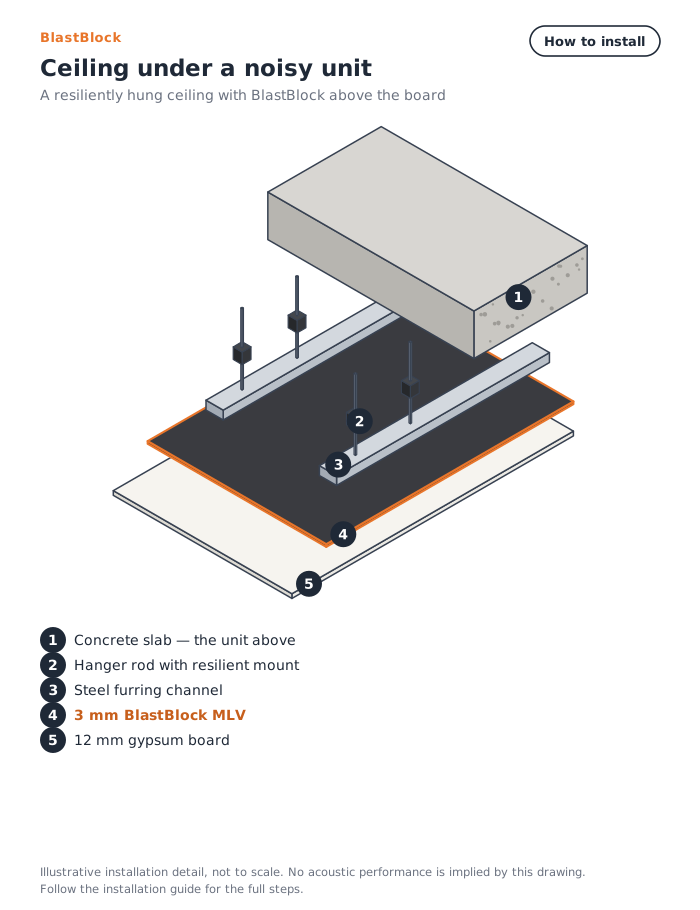
| Footsteps from above | Impact through the slab | Resiliently hung ceiling, or soft flooring in the unit above |
| Traffic, BTS or expressway | Sliding windows and vents | Seal the frame, then consider secondary glazing |
What Bangkok construction actually looks like behind the finishes
Towers built here over the last two decades share a fairly consistent set of details. Knowing them saves you opening the wrong wall.
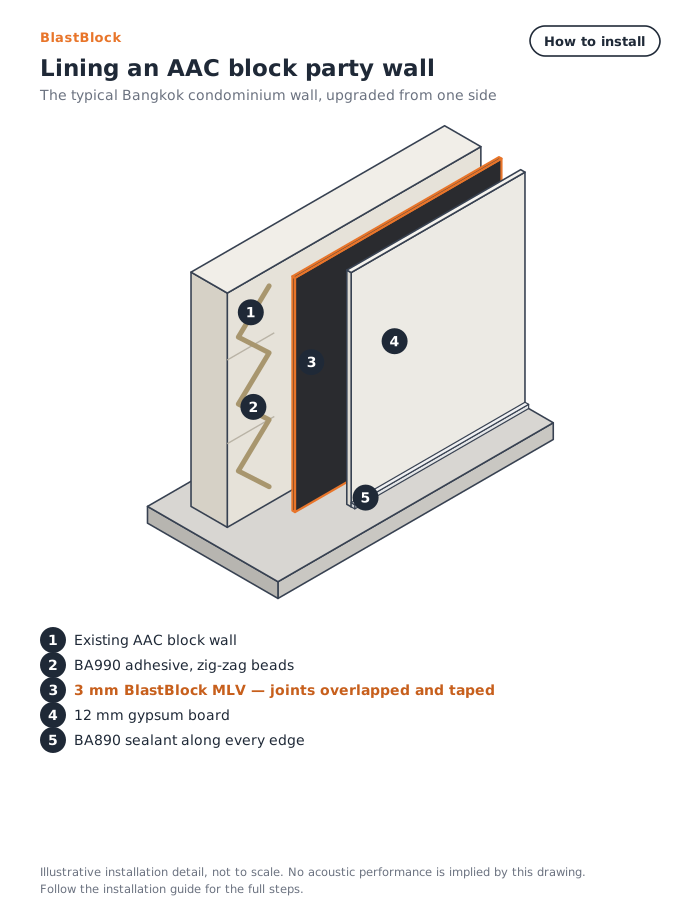
- Party walls between units are usually autoclaved aerated concrete block or lightweight steel-stud plasterboard. AAC is light for masonry — good thermally, weak acoustically compared with dense block or concrete.
- The party wall very often stops at the suspended ceiling rather than continuing to the soffit. The void above is then continuous between units, and sound simply goes over the top. This is the single most common reason a well-built wall lining disappoints.
- Air-conditioning refrigerant pipes and condensate drains pass through sleeved holes that are foamed, not sealed. Expanding foam is not an acoustic seal.
- Socket and switch boxes are frequently installed back to back in the same stud bay, which is a direct hole through the wall.
- Windows are typically sliding aluminium units. The sliding interface leaks by design, and no amount of internal wall work will change what comes through it.
- Floor slabs are bare structural concrete with hard tile or laminate over. Footfall from the unit above transmits through the structure, and no wall treatment reaches it.
Step 2: the build-up that works
Once you have confirmed the party wall is genuinely the dominant path, the approach is to add mass, keep the layer continuous, and seal everything. Mass loaded vinyl suits condominium work because it delivers useful mass at about 3 mm, and floor area in a Bangkok unit is expensive.
- Seal the door: perimeter seals and a drop seal or threshold. Do this first and listen again before ordering anything else.
- Back the socket and switch boxes on the party wall with BA650 putty pads.
- Pack and seal every service penetration with a flexible acoustic sealant. Do not use rigid mortar around a pipe — it makes a solid bridge.
- Close the ceiling void at the party wall line, and seal that closure. Skipping this undoes most of the work below it.
- Fix the MLV to the wall with BA990 adhesive, overlapping the sheets at joints and taping the joints closed.
- Seal every edge — head, base and both sides — with BA890 sealant. There is no such thing as a small gap here.
- Overboard with 12 mm plasterboard and seal the board perimeter again before skimming.
- Only if that is still not enough, consider mineral wool in the cavity or an independent second leaf on its own studs.
STC by wall build-up, according to the manufacturer’s datasheet, reference BB830/20/v2. These are laboratory values; a finished wall in an occupied building normally lands 5 to 10 dB lower, and the difference is almost always sealing and flanking.
| Build-up | STC |
|---|---|
| 12 mm plasterboard, steel studs, 12 mm plasterboard | 33 |
| As above, with 3 mm MLV added within the wall | 51 |
| 3 mm MLV plus 50 mm mineral wool in the cavity | 53 |
| 3 mm MLV to both faces, 50 mm mineral wool | 56 |
| Double stud, separate frames, 50 mm cavity, mineral wool | 68 |
Read that table as an order of priority rather than as a promise. Mass first, cavity absorption second, structural separation last — it gives the largest gain but costs the most in both money and floor area.
A worked budget for one wall
Take a bedroom party wall 4 m wide and 3 m high: 12 m². Allow roughly 20% for overlaps at joints and offcuts, which means ordering 15 m². MLV is sold in whole 5 m² rolls, so that is three rolls. Prices below include 7% VAT and cover acoustic materials only — no labour, plasterboard, skim or decoration.
| Item | Quantity | Total incl. VAT |
|---|---|---|
| BB830 MLV, 5 m² rolls | 3 rolls (15 m²) | 16,836 |
| BA890 acoustic sealant | 4 cartridges | 1,788 |
| BA990 adhesive | 4 cartridges | 2,184 |
| BA650 putty pads | 4 pads | 1,800 |
| Total acoustic materials | about 22,600 |
Installed, including labour, plasterboard and making good, one wall of this size typically lands between THB 30,000 and THB 45,000 in Bangkok. Door sealing, by contrast, is a few thousand baht and often produces the larger perceived change. Do it first.
What not to spend money on
- Egg-crate foam and decorative acoustic panels. They absorb within your own room and add no meaningful mass, so they do nothing about a neighbour.
- Heavy curtains, for anything other than reverberation and a small amount of high-frequency window leakage.
- Carpet or rugs, if the problem is footfall from above. They help the floor below you, not you.
- Acoustic paint and thin sprayed coatings. Nothing a few tenths of a millimetre thick adds meaningful mass.
- A second layer of MLV over an unsealed first layer. Sealing the first layer properly is worth more than doubling the material.
Before you start: rules and practicalities
- The party wall between units is usually common property. Notify the juristic person before starting, and expect restrictions on drilling into it.
- The build-up adds about 20 to 30 mm per face once plasterboard is included. Check door frames, skirtings, sockets and any wall-mounted air-conditioning unit before you commit.
- In a rented unit, agree reinstatement in writing first. MLV bonded and overboarded is not a reversible alteration.
- Buildings commonly restrict noisy work to weekday working hours. Plan the programme around it.
- Delivery and installation are within Thailand only.